

Choosing a non-emergency medical transportation (NEMT) platform is an important decision for transportation providers, brokers, PACE programs, and healthcare organizations. The right software can help coordinate rides, manage drivers, streamline billing, improve visibility into daily operations, and maintain more consistent transportation records.
However, not every transportation management platform is designed for the specific demands of NEMT. A system that handles basic scheduling may not provide the reporting, credential tracking, payer-specific workflows, or operational flexibility needed to manage a growing transportation program.
Before selecting a platform, it is important to evaluate how well the software supports your entire operation, from the initial ride request through trip completion, billing, and performance reporting.
This guide explains the essential features to look for in NEMT software, the questions to ask vendors, and how to use a practical selection checklist to make a more informed decision.
Why the Right NEMT Platform Matters
NEMT operations involve more than arranging transportation from one location to another. Teams must coordinate trip requests, match riders with appropriate transportation, manage driver availability, respond to last-minute changes, maintain trip records, and reconcile billing information.
When these processes rely on disconnected tools or manual work, teams may spend more time correcting errors, tracking down information, and preparing reports.
A purpose-built NEMT platform can bring these workflows together, helping organizations improve operational visibility and manage transportation more consistently.
The most suitable platform depends on your organization’s size, service model, trip volume, funding arrangements, and technology requirements. A small provider may prioritize ease of use and predictable costs, while a broker or large transportation organization may need more advanced routing, integrations, reporting, and configuration options.
12 Essential Features to Look for in NEMT Software
1. Automated Scheduling and Trip Management
Scheduling is one of the most important capabilities in an NEMT platform. Teams need to create trips, manage recurring appointments, account for rider requirements, and coordinate transportation resources without relying entirely on manual processes.
Look for software that supports:
- Single and recurring trip scheduling.
- Trip requests from different sources.
- Configurable scheduling rules and requirements.
- Changes, cancellations, and return-trip coordination.
- Visibility into trip assignments and scheduling conflicts.
- Scheduling workflows suited to your organization’s operating model.
Why it matters: More structured scheduling can reduce administrative effort, improve coordination, and help teams manage increasing trip volumes.
Questions to ask vendors:
- Can the platform accommodate our recurring trips and scheduling rules?
- How are scheduling conflicts identified?
- Can staff adjust trips without disrupting the rest of the schedule?
2. Real-Time Dispatch and Trip Coordination
Dispatch teams must respond to changing schedules, driver availability, cancellations, delays, and urgent operational adjustments.
Your NEMT dispatch software should give dispatchers a centralized view of assigned trips and allow them to communicate changes to drivers efficiently.
Look for:
- Centralized dispatch dashboards.
- Quick trip assignment and reassignment.
- Visibility into driver and vehicle assignments.
- Support for same-day changes and cancellations.
- Updated trip information for drivers and dispatchers.
- Operational visibility that supports timely decision-making.
Why it matters: Better dispatch coordination can help reduce confusion, limit unnecessary manual communication, and support more reliable service delivery.
3. Route Optimization and Vehicle Utilization
Route planning affects driver time, mileage, fuel expenses, and the number of trips a fleet can complete.
Evaluate whether the platform supports routing capabilities that match your service area and transportation requirements.
Important considerations include:
- Route optimization and geographic scheduling.
- Appropriate handling of pickup and drop-off windows.
- Support for recurring routes and multiple stops.
- Integration with mapping or GPS services.
- Visibility into route changes and trip progress.
- Configurable routing constraints for your operation.
Why it matters: Efficient routing can help organizations make better use of available vehicles and drivers while balancing operational costs with service requirements.
Do not evaluate routing solely on the shortest distance. NEMT operations must also account for appointment times, rider needs, vehicle suitability, and applicable service requirements.
4. Billing, Claims Management, and Reimbursement Workflows
Billing errors and incomplete trip information can delay reimbursement and increase administrative work.
NEMT billing software should connect transportation records with the information needed to prepare, review, submit, and reconcile invoices or claims.
Look for:
- Support for relevant payer and contract requirements.
- Electronic billing and claims workflows, where applicable.
- Trip completion data linked to billing records.
- Identification of missing or inconsistent information.
- Claim status visibility and rejection tracking.
- Reporting and exports for financial reconciliation.
- Support for applicable documentation and audit requirements.
Why it matters: Connecting trip operations with billing can reduce duplicate data entry, make discrepancies easier to investigate, and improve visibility into outstanding payments.
Before purchasing, verify which payers, billing formats, integrations, and claim workflows the vendor actually supports. These capabilities vary by product configuration and contract.
5. Compliance and Credential Management
NEMT organizations may need to maintain driver licenses, vehicle documentation, insurance information, training records, and other credentials required by their programs or contracts.
A suitable platform should help staff organize these records and monitor relevant expiration dates.
Look for:
- Centralized driver and vehicle records.
- Credential expiration tracking.
- Reminders for upcoming renewals.
- Visibility into missing or expired documentation.
- Reporting to support internal reviews.
- Workflows that help staff verify eligibility before assigning trips.
Why it matters: Organized records can help reduce missed renewals, support more consistent oversight, and make required documentation easier to retrieve.
Software can support compliance management, but it does not automatically guarantee compliance. Your organization must still verify applicable federal, state, payer, and contractual requirements.
6. Mobile Driver Applications
Drivers need accurate trip information while away from the office. Mobile tools can help keep drivers and dispatchers aligned throughout the service day.
Evaluate whether the driver application provides:
- Access to assigned trips and manifests.
- Pickup and drop-off details.
- Navigation and relevant trip updates.
- Trip status and completion recording.
- Electronic documentation, where supported.
- Communication with dispatch.
- A practical workflow for the devices your drivers use.
Why it matters: A connected driver workflow can reduce reliance on paper manifests and repeated phone calls while improving the consistency of trip records.
During a demonstration, ask vendors to show the actual driver workflow, including what happens when a trip changes after the driver has received the original assignment.
7. Reporting and Operational Analytics
Transportation leaders need more than a daily list of trips. They need reliable information to understand performance, costs, service delivery, and operational bottlenecks.
Useful reporting capabilities may include:
- Trip volume and completion reports.
- Driver and vehicle productivity.
- On-time performance, where data is available.
- Cancellations and no-shows.
- Billing, reimbursement, and claim status.
- Utilization and operational cost measures.
- Data exports and configurable report formats.
Why it matters: Accurate reporting can help managers identify patterns, investigate issues, and make decisions based on operational evidence rather than assumptions.
Ask whether reports can be filtered by date, location, payer, provider, program, or other relevant dimensions. Also confirm how data is defined, updated, exported, and retained.
8. Electronic Visit Verification and Reliable Trip Records
Depending on the services and applicable program requirements, transportation organizations may need electronic records that help verify when and where a service occurred.
Evaluate whether the platform captures the trip information required by your contracts and applicable Electronic Visit Verification (EVV) workflows.
Potentially relevant capabilities include:
- Trip timestamps.
- GPS or location information, where supported.
- Electronic trip completion records.
- Required signatures or supporting documentation, where applicable.
- Links between trip records and billing workflows.
- Identification of missing or inconsistent information.
Why it matters: Consistent trip records can support reconciliation, reporting, and audit preparation.
EVV requirements are not identical across all transportation programs. Confirm the specific requirements applicable to your service model rather than assuming that any system with GPS tracking satisfies them.
9. Client Notifications and Passenger Communication
Reliable communication can improve the transportation experience for members, caregivers, facilities, and other stakeholders.
Look for notification capabilities that support:
- Trip reminders.
- Pickup status and schedule updates.
- Notifications about delays or changes.
- Configurable communication preferences.
- Relevant caregiver or facility communication workflows.
Why it matters: Timely updates can help riders plan for transportation and reduce uncertainty when schedules change.
Ask vendors which communication channels are supported and whether notifications can be configured for different rider groups or operational scenarios.
10. Online Booking and Passenger Portals
A passenger portal can give authorized users a way to request or manage transportation without contacting staff for every routine change.
Depending on the platform, useful features may include:
- Online trip requests.
- Trip status visibility.
- Booking changes and cancellations.
- Access for caregivers or participating facilities.
- Secure access to relevant transportation information.
Why it matters: Self-service capabilities can reduce repetitive administrative work and provide a more convenient experience for users.
Check how booking requests are reviewed, whether approval rules are supported, and how portal activity connects with the central scheduling workflow.
11. Integrations and Data Exchange
NEMT organizations often work with external brokers, healthcare organizations, funding sources, financial systems, and other operational tools.
A platform should fit into your existing technology environment rather than create another isolated source of data.
Evaluate:
- Available APIs and integration options.
- Electronic trip request and completion-data exchange.
- Connections with relevant broker or payer systems.
- Billing and accounting exports.
- Data import and migration support.
- Error handling and integration monitoring.
- Documentation and ownership of integration maintenance.
Why it matters: Effective data exchange can reduce duplicate entry and help keep information consistent across connected systems.
Do not assume that an advertised integration supports every required workflow. Request confirmation of the exact systems, data fields, direction of exchange, and implementation requirements.
12. Security, Scalability, and Vendor Support
A platform should be suitable for your organization’s current needs and capable of supporting its expected growth.
Evaluate the following areas:
Security and privacy
- Role-based access and permissions.
- Authentication and access controls.
- Data backup and recovery procedures.
- Security documentation and incident response processes.
- Appropriate safeguards for sensitive health information.
Scalability
- Ability to accommodate increased trip volume.
- Support for additional users, locations, or service programs.
- Flexibility to configure operational workflows.
- Performance under your expected workload.
Implementation and support
- Data migration and onboarding assistance.
- Staff training and documentation.
- Technical support availability and escalation.
- Product update and maintenance processes.
- Clear implementation responsibilities and costs.
Why it matters: The platform must work reliably in day-to-day operations, not simply perform well during a sales demonstration.
Ask vendors to document their security controls and contractual commitments. A statement that a system supports HIPAA-related requirements should not replace your own review of the vendor’s safeguards, agreements, and responsibilities.
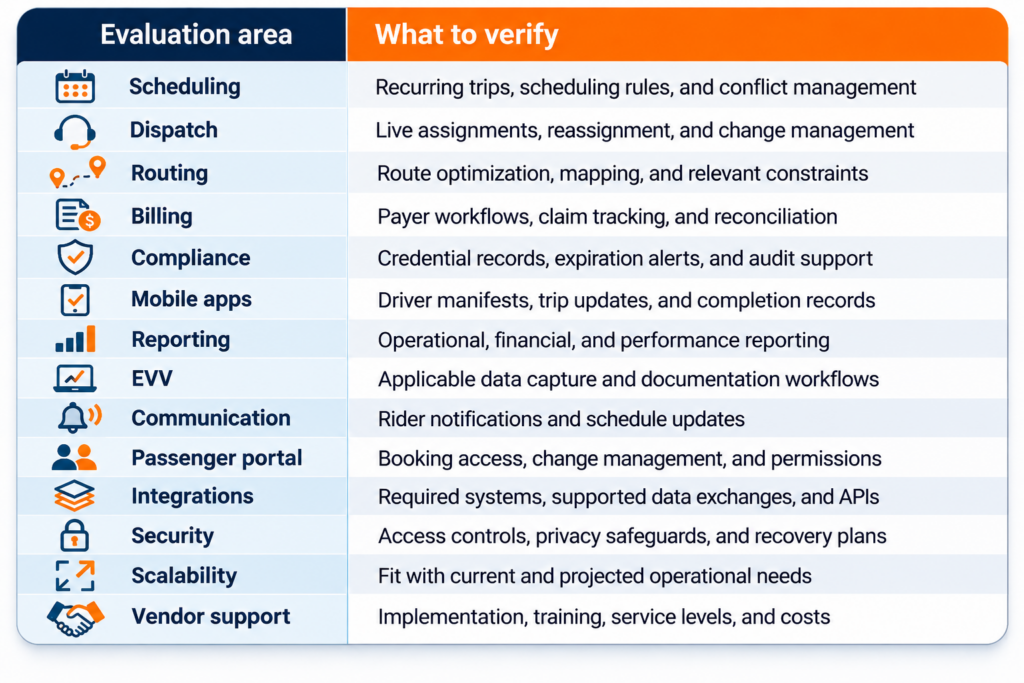
NEMT Software Selection Checklist
Use the following checklist when comparing platforms. Mark a feature as confirmed only after the vendor demonstrates it or provides suitable documentation.
How to Compare NEMT Platforms Before Making a Decision
A feature list is a starting point, not a purchasing decision. Two vendors may advertise similar capabilities while offering very different workflows, integration options, and levels of flexibility.
Use a structured evaluation process.
Step 1: Document Your Operational Requirements
Identify your organization type, trip volume, fleet size, service areas, payer arrangements, current systems, and major operational challenges.
Separate essential requirements from features that would be useful but are not immediately necessary.
Step 2: Prioritize Requirements
Assign each requirement a priority:
- Must have: Necessary for core operations or applicable obligations.
- Important: Materially improves efficiency, reporting, or service delivery.
- Optional: Useful for future expansion or a later implementation phase.
This prevents an attractive but unnecessary feature from outweighing a critical operational requirement.
Step 3: Ask Vendors to Demonstrate Real Workflows
Use the same scenarios for each vendor. For example:
- Schedule a recurring trip.
- Reassign a driver after a cancellation.
- Record trip completion.
- Identify missing billing information.
- Review a credential expiration.
- Generate an operational report.
Observe how many manual steps are required and whether the workflow fits your team’s needs.
Step 4: Evaluate Total Cost and Implementation Effort
Look beyond the subscription or licensing fee. Ask about implementation, integrations, training, support, additional modules, data migration, and ongoing maintenance.
A lower upfront price is not necessarily the lowest total cost of ownership.
Step 5: Score the Vendors and Validate the Results
Create a weighted scorecard based on your requirements. Require evidence for important claims, and involve operations, finance, compliance, dispatch, and IT stakeholders in the final evaluation.
Choosing the Right NEMT Platform for Your Organization
The best NEMT software depends on the complexity of your operation.
Smaller transportation providers may prioritize accessible scheduling, dispatch, billing, and driver tools. Larger providers and brokers may need more extensive routing, reporting, integration, and configuration capabilities. PACE programs and healthcare organizations may place additional emphasis on coordinating transportation with participant needs and other services.
The objective is not to purchase the platform with the longest feature list. It is to select a system that supports your workflows, addresses your operational challenges, and can adapt as your requirements evolve.
Explore Momentm’s NEMT Software Solutions
Momentm Technologies offers NEMT software designed for transportation providers, brokers, PACE programs, and other health and human services organizations.
Its solutions include scheduling, dispatch, routing, billing, reporting, driver applications, passenger communication, and credential management. The appropriate solution depends on your organization’s size, requirements, and operating model.
Explore Momentm’s NEMT software features to learn more about its capabilities.
Ready to evaluate a platform for your transportation operation? Schedule a demo with Momentm to discuss your operational requirements and determine which solution may be the right fit.
Frequently Asked Questions
What features should NEMT software have?
Essential capabilities generally include scheduling, dispatch, routing, billing, reporting, driver and vehicle credential tracking, mobile driver tools, and trip documentation. Organizations may also require passenger portals, notifications, integrations, and program-specific compliance workflows.
How do I choose the best NEMT platform?
Start by documenting your operational requirements, identifying essential integrations, comparing vendor workflows, reviewing total costs, and validating security and compliance capabilities. Request demonstrations using real scenarios from your operation.
Can NEMT software help reduce billing errors?
NEMT software can connect trip completion records with billing workflows, flag certain missing or inconsistent information, and support claims reconciliation. Results depend on configuration, data quality, payer requirements, and staff processes.
Does NEMT software support Medicaid compliance?
Some platforms provide tools for credential tracking, trip documentation, billing, and reporting that can support compliance processes. However, requirements vary by state, program, payer, and contract. Software alone does not guarantee compliance.
What is the difference between NEMT software and general transportation management software?
NEMT software is designed around the operational needs of non-emergency medical transportation, which may include rider-specific requirements, funding and billing workflows, transportation documentation, provider credentials, and program reporting. General transportation software may not support these requirements without customization or additional integrations.