
Medicaid transportation providers operate in an environment where accurate records, qualified drivers, appropriate vehicle documentation, and reliable billing processes are essential to day-to-day operations.
For non-emergency medical transportation (NEMT) organizations, compliance involves more than keeping paperwork on file. Teams need repeatable processes for verifying credentials, documenting completed trips, reviewing billing information, maintaining records, and responding to program or payer requirements.
The challenge is that Medicaid transportation requirements are not identical across every state or delivery model. Federal requirements provide a baseline, while state Medicaid agencies, transportation brokers, managed care organizations, and individual contracts may establish additional requirements.
This Medicaid transportation compliance checklist helps NEMT providers organize their compliance processes, identify documentation gaps, and evaluate where transportation management software can support day-to-day oversight.
Important: This checklist is an operational guide, not legal advice or a complete statement of every applicable requirement. Providers should verify current federal and state rules, Medicaid agency guidance, payer contracts, and broker requirements for their specific service model.
Understanding Medicaid Transportation Compliance
Medicaid transportation programs help eligible beneficiaries access covered healthcare services. The Centers for Medicare & Medicaid Services (CMS) explains that states must assure necessary transportation for beneficiaries under applicable federal requirements, while states have flexibility in how they organize and deliver these services.
CMS also outlines minimum requirements relating to NEMT providers and drivers, including requirements concerning federal healthcare program exclusions, driver licensing, processes addressing state drug-law violations, and disclosure of driver driving histories. The exact implementation and additional requirements must be checked against the applicable state program.
For providers, this means compliance should be treated as an ongoing operational process rather than a one-time onboarding exercise.
A useful approach is to organize compliance into six areas:
- Provider and driver eligibility.
- Vehicle documentation and operational readiness.
- Trip authorization and service documentation.
- Billing and claims management.
- Reporting, record retention, and audit preparation.
- Technology controls and staff training.
For the federal policy baseline, review the official CMS Assurance of Transportation guidance.
Medicaid Transportation Compliance Checklist
1. Verify Provider Enrollment and Eligibility
Before delivering covered transportation services, confirm that your organization meets the enrollment, qualification, and contracting requirements that apply to its role.
Your review should include:
- Confirming current enrollment or authorization under the applicable Medicaid program, where required.
- Maintaining relevant provider identification and registration records.
- Reviewing broker, managed care, or payer agreements.
- Confirming that required provider attestations have been completed.
- Establishing a process to check applicable federal healthcare program exclusion requirements.
- Maintaining records supporting eligibility and authorization to provide services.
- Assigning responsibility for monitoring changes in enrollment or contract status.
Why this matters: Inaccurate or outdated provider information can create operational and payment problems. Centralized records and defined review responsibilities help teams identify issues before they affect service delivery.
Recommended practice: Maintain a master provider record that includes applicable enrollment status, relevant contract information, required documentation, review dates, and the person responsible for follow-up.
2. Maintain Driver Credentials and Required Screening Records
Driver qualifications are a critical part of NEMT compliance. Federal requirements establish certain minimum assurances, and states, brokers, or contracts may impose additional screening, training, and documentation obligations.
Use the following checklist to structure your review:
- Verify that each driver holds a valid driver’s license.
- Maintain the driver documentation required by the applicable program.
- Establish processes for addressing state drug-law violations where required.
- Follow applicable processes for reviewing and disclosing driving histories, including traffic violations.
- Check relevant federal healthcare program exclusion requirements.
- Complete required background checks, training, or other screening where applicable.
- Record credential expiration dates and renewal requirements.
- Define who reviews new credentials and approves drivers for service.
- Establish a process for responding to expired, missing, or invalid credentials.
Requirements can differ by state and transportation arrangement. Do not assume that one screening checklist is sufficient for every contract or jurisdiction.
How software helps: NEMT credential management tools can centralize driver records, track expiration dates, and provide reminders for upcoming renewals. These workflows can help staff identify documentation issues and maintain more consistent oversight.
For example, Momentm’s transportation provider solutions include credential management capabilities designed to help organizations track driver and vehicle documentation.
3. Review Vehicle Documentation and Readiness
Vehicle requirements may vary based on the transportation mode, vehicle type, state regulations, payer contracts, and the needs of the riders being transported.
Your vehicle compliance process should address:
- Maintaining current vehicle registration and insurance records, as applicable.
- Tracking inspections and other required vehicle documentation.
- Recording relevant permits or authorizations where required.
- Maintaining accessible documentation for vehicles assigned to service.
- Monitoring expiration and renewal dates.
- Documenting vehicle maintenance and inspection processes as required by applicable rules or contracts.
- Confirming that vehicles meet applicable service and rider requirements.
- Defining how vehicles with missing or expired credentials are handled.
Why this matters: A provider needs a reliable process for checking whether a vehicle is eligible and suitable for a particular assignment.
Recommended practice: Maintain a centralized vehicle register and define who can approve vehicles for dispatch. Where the software supports it, use credential records and alerts to help staff identify missing or expired documentation before assigning trips.
Do not rely on an expiration reminder alone. Establish a documented review and escalation process for unresolved issues.
4. Confirm Trip Authorization and Eligibility Workflows
Accurate trip records begin before the vehicle leaves the facility. Providers should understand which authorization, eligibility, and documentation checks apply to the services they deliver.
Depending on the program and contract, the process may involve:
- Confirming the trip request came through an authorized channel.
- Verifying relevant beneficiary eligibility or authorization information.
- Checking the applicable service type and funding arrangement.
- Recording required pickup, destination, scheduling, and trip details.
- Confirming that the assigned provider and vehicle meet applicable requirements.
- Documenting approved changes, cancellations, and exceptions.
- Retaining relevant authorization records.
- Establishing a process for resolving incomplete or conflicting information.
The exact checks required depend on the program, payer, and service arrangement. Confirm these details with the relevant Medicaid agency, broker, or contracting organization.
How software helps: Centralized scheduling and dispatch workflows can keep trip details, assignments, and updates organized. Integrating those records with billing and reporting processes can reduce the need to reconstruct trip histories from disconnected systems.
5. Document Completed Trips and Applicable EVV Data
Trip completion records can be important for billing, reconciliation, contract oversight, and audit preparation. Where Electronic Visit Verification (EVV) requirements apply, providers should verify which data elements and verification processes are required for their particular service.
Review the following:
- Record trip completion using the required process.
- Capture applicable timestamps and location information.
- Maintain required signatures or supporting documentation, where applicable.
- Record exceptions, cancellations, and relevant service changes.
- Identify missing or inconsistent trip information.
- Link trip completion information to the relevant authorization and billing record.
- Define how corrections are reviewed and documented.
- Retain records according to applicable program, contractual, and legal requirements.
Why this matters: Incomplete or inconsistent records can complicate claims review and make it harder to explain what happened during a trip.
How software helps: A connected dispatch, trip completion, and billing workflow can make relevant records easier to retrieve and compare. GPS information and timestamps may support verification processes when they meet the applicable requirements.
However, GPS tracking by itself does not establish that a system meets every EVV requirement. Providers must verify the required data elements, capture methods, integrations, and program-specific rules.
6. Strengthen Billing and Claims Documentation
Billing controls should help ensure that submitted charges are supported by accurate transportation records and comply with applicable payer requirements.
Use this checklist:
- Confirm the applicable payer, contract, and billing rules.
- Verify that required trip documentation is available before submission.
- Check relevant authorization and eligibility information.
- Review billing data for missing or inconsistent fields.
- Confirm that charges correspond to the services and rates permitted by the applicable arrangement.
- Track claims submitted, pending, rejected, or paid.
- Investigate rejected claims and document corrections.
- Reconcile trip records with invoices, payments, and adjustments.
- Maintain the supporting documentation required for review or audit.
- Restrict access to sensitive billing and beneficiary information appropriately.
Why this matters: Billing accuracy depends on the quality of the underlying records as well as the correctness of the billing process.
How software helps: NEMT billing systems can connect trip data with claims and invoicing workflows, flag certain documentation gaps, and help staff track payment status. Reporting and data exports can also support reconciliation and review.
Explore Momentm’s NEMT billing and claims management capabilities to learn how connected transportation and billing workflows can support these processes.
7. Prepare for Audits and Record Requests
Audit preparation should be part of routine operations rather than a last-minute effort.
A consistent process helps staff retrieve records, explain discrepancies, and respond to requests from authorized reviewers.
- Identify the record-retention requirements that apply to each program and contract.
- Maintain organized provider, driver, vehicle, trip, and billing records.
- Define who can access and retrieve records.
- Establish procedures for responding to authorized record requests.
- Review exceptions, rejected claims, and unresolved discrepancies.
- Document corrections and relevant follow-up actions.
- Maintain appropriate access controls and safeguards for sensitive information.
- Conduct periodic internal reviews based on operational risks.
- Track corrective actions through completion.
Why this matters: A well-organized record system makes it easier to respond to requests and identify weaknesses before they become larger operational problems.
How software helps: Reporting and centralized record management can reduce the time spent collecting information from separate spreadsheets, paper records, and disconnected systems.
Momentm’s NEMT software includes reporting capabilities designed to support operational visibility and the review of transportation records.
8. Review Reporting and Performance Monitoring
Compliance oversight is stronger when teams can identify exceptions and review performance regularly.
Consider monitoring:
- Missing or expired driver and vehicle credentials.
- Incomplete trip records.
- Claims rejected for documentation or data issues.
- Differences between completed trips and billed services.
- Unresolved exceptions and corrective actions.
- Contract-specific reporting requirements.
- Recurring operational patterns that require investigation.
Reporting requirements differ by program and contract. Confirm which measures must be submitted externally and which are useful for internal oversight.
Recommended practice: Establish a review cadence that reflects the risk and volume of your operation. Assign owners to exceptions, set reasonable resolution deadlines, and document the actions taken.
9. Establish Staff Training and Accountability
Even a well-designed system will not solve compliance problems if staff do not understand the processes they must follow.
Your organization should:
- Document core operational and compliance procedures.
- Train staff on their responsibilities.
- Explain how missing or conflicting information should be handled.
- Train staff on the proper use of scheduling, dispatch, trip completion, and billing tools.
- Define escalation procedures for unresolved issues.
- Review procedures when applicable requirements or contracts change.
- Maintain training records where required.
- Periodically assess whether documented procedures are followed in practice.
Assign clear ownership across operations, dispatch, billing, credential management, and compliance. When responsibilities are unclear, exceptions are more likely to remain unresolved.
10. Evaluate Whether Your Technology Supports Your Compliance Process
Technology can help organize compliance activities, but the platform must support the actual requirements of your business.
When evaluating NEMT software, ask:
- Can the system centralize driver and vehicle credentials?
- Can it identify upcoming credential expirations?
- Can trip completion records be connected to billing?
- Can staff review missing or inconsistent trip information?
- Does it support the documentation workflows required by our contracts?
- Can it generate relevant operational and financial reports?
- Can authorized users retrieve records efficiently?
- Does it provide appropriate access controls and security documentation?
- Can it exchange data with the brokers, payers, or systems we use?
- Can the vendor demonstrate how the configured platform supports our specific workflows?
Ask the vendor to demonstrate these capabilities using your actual operating scenarios. Verify which functions are included, which require configuration or additional modules, and which rely on external integrations.
Medicaid Transportation Compliance: A Practical Review Schedule
A structured schedule can help turn a checklist into an operational process. The schedule below is a starting point, not a universal regulatory deadline. Adjust it to applicable requirements and risk levels.
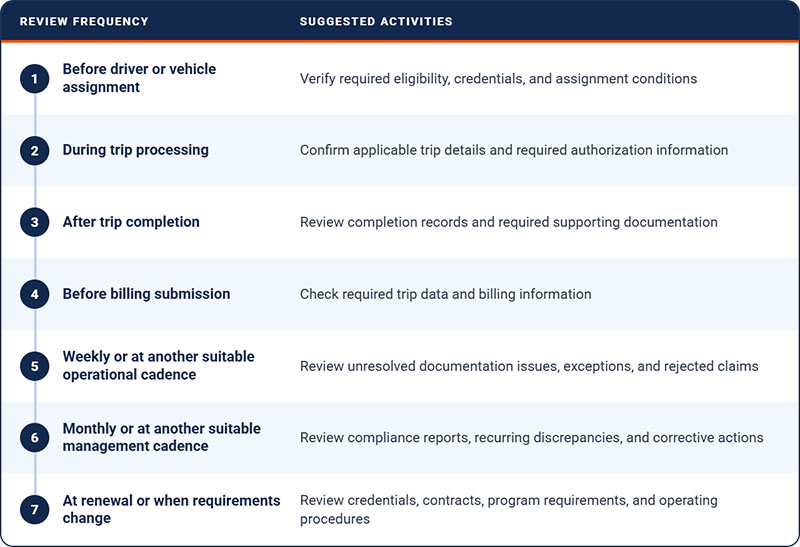
The objective is to catch issues as early as possible, assign responsibility for resolving them, and maintain a clear record of the actions taken.
Common Medicaid Transportation Compliance Mistakes to Avoid
Treating compliance as a one-time onboarding task
Driver and vehicle credentials, contracts, and program requirements can change. Establish ongoing review processes rather than relying exclusively on initial checks.
Relying on spreadsheets without clear ownership
Spreadsheets can be useful, but they become difficult to manage when multiple people maintain separate versions. If spreadsheets remain part of the process, establish a clear source of truth, access controls, review ownership, and update procedures.
Submitting claims without checking supporting records
A completed trip does not automatically mean that a claim is ready to submit. Ensure that the documentation and billing information required by the applicable payer are available and consistent.
Assuming every state has the same requirements
Federal requirements provide a baseline, but states and contracting organizations may have different operational, documentation, screening, and reporting requirements. Validate requirements for each relevant program and contract.
Assuming software guarantees compliance
Software can organize information, support workflows, and identify certain exceptions. It cannot replace accurate data, staff accountability, appropriate procedures, or an understanding of applicable requirements.
How NEMT Software Can Support Compliance Management
Managing compliance across disconnected systems can create unnecessary administrative work. When credential records, trip information, billing data, and operational reports are maintained separately, staff may need to reconcile information manually.
A connected NEMT platform can help by supporting:
- Centralized credential management: Organize driver and vehicle records and monitor expiration dates.
- Connected trip workflows: Keep scheduling, dispatch, and trip completion information aligned.
- Billing and claims visibility: Help staff review supporting trip data, identify discrepancies, and track claim status.
- Reporting and audit preparation: Make relevant operational and financial information easier to review.
- More consistent communication: Keep drivers, dispatchers, and authorized stakeholders aligned when trips change.
The value depends on how the platform is configured, the quality of its data, and whether its workflows meet your specific requirements.
Explore Momentm’s NEMT Software
Momentm Technologies provides transportation management software for NEMT providers, brokers, PACE programs, and other health and human services organizations.
Its NovusMED solution includes capabilities for scheduling, dispatch, billing, reporting, and credential management. These tools can help organizations organize operational information and support their compliance processes.
Explore Momentm’s NEMT software solutions to understand the available capabilities.
Looking to improve visibility into your transportation operations and compliance workflows? Connect with Momentm to discuss your organization’s requirements and see how its software may support your processes.
Frequently Asked Questions
What are the Medicaid transportation requirements for NEMT providers?
Requirements depend on the applicable federal rules, state Medicaid program, transportation delivery model, payer, and contract. Providers should verify enrollment and driver requirements, vehicle documentation, trip records, billing processes, and any additional screening or reporting obligations that apply to their services.
What documents should NEMT providers maintain?
Depending on the program, records may include provider enrollment information, driver licenses and required screening documentation, vehicle records, contracts, trip authorizations, completed trip records, billing documentation, claims records, and audit-related correspondence. The applicable program and contract determine which records are required and how long they must be retained.
How can NEMT providers prepare for a Medicaid audit?
Establish a documented record-retention process, keep trip and billing information organized, review unresolved discrepancies, define responsibilities for retrieving records, and ensure that authorized staff can access supporting documentation. Conduct periodic internal reviews and track corrective actions.
Does NEMT software automatically ensure Medicaid compliance?
No. Software can support credential tracking, trip documentation, billing workflows, and reporting, but it does not guarantee compliance. Providers remain responsible for following applicable requirements, maintaining accurate records, configuring workflows appropriately, and training staff.
Do EVV requirements apply to all NEMT providers?
EVV applicability depends on the services, program, and relevant rules. Providers should verify whether EVV applies to their particular service arrangement and which data elements and verification methods are required. GPS tracking alone should not be assumed to satisfy all EVV requirements.
How often should NEMT providers review compliance records?
Review frequency should reflect applicable rules, contract deadlines, credential expiration dates, operational risk, and the volume of transportation services. Time-sensitive checks should occur before relevant assignments or transactions, while broader management reviews can follow an established weekly or monthly cadence where appropriate.
Official Resource for Medicaid Transportation Guidance
For federal guidance on Medicaid transportation assurance and minimum NEMT provider and driver requirements, consult the Centers for Medicare & Medicaid Services (CMS). Providers should also consult their state Medicaid agency and relevant broker, managed care, or payer documentation for current, program-specific requirements.