
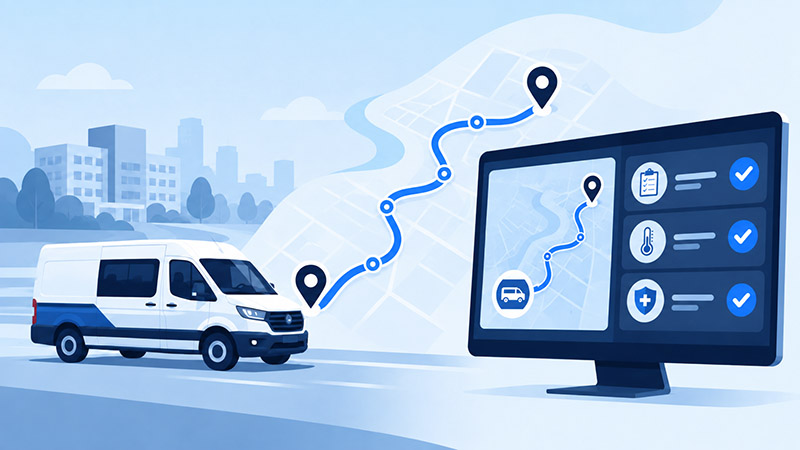
Most NEMT providers think about GPS and EVV (electronic visit verification) data as a claims problem: capture it correctly, get paid, move on. But that data doesn’t stop working once a claim clears. Many transportation brokers also feed the same GPS timestamps, pickup and drop-off locations, and trip completion records into ongoing performance scorecards, separate from whether any individual claim was approved. EVV compliance for NEMT is no longer just about getting a claim paid. It’s also the raw material brokers use to decide how much trip volume you get next month.
Two Systems, One Data Trail
Every trip your drivers run generates a single data trail: pickup time, drop-off time, route, and completion status. That trail feeds two separate systems on the broker’s side. The first is claims adjudication, which checks whether the trip meets EVV requirements well enough to approve payment. The second is a performance layer that brokers use to track patterns across your entire operation over time. Some patterns they look for are on-time rates, trip completion consistency, and how often your reported data lines up cleanly with what their systems capture independently.
A trip can pass the first system and still hurt you in the second. If your GPS data is thin, delayed, or inconsistent even when the claim technically pays, that pattern shows up in your standing with the broker.
What Brokers Are Actually Watching
Brokers vary in the specifics, but the categories are consistent across the industry: on-time performance, trip completion rates, complaint volume, and how clean and complete your trip documentation is. None of this shows up as a denied claim. They translate to fewer trips assigned to you, slower payment cycles, or more frequent audits, often before you’d notice anything was wrong from your billing reports alone.
This is worth flagging honestly: the exact thresholds each broker uses aren’t always published, and providers often learn them the hard way. What is consistent is the underlying mechanism. If your dispatch and EVV data isn’t captured cleanly and consistently at the moment a trip starts, you’re building a weaker record than you realize.
Where the Gap Actually Starts
Inconsistent or undocumented trip completion data is not because providers are cutting corners. They’re running EVV as a separate tool bolted onto their dispatch system. When these systems can’t communicate cleanly, drivers end up entering trip details twice, timestamps get reconstructed after the fact instead of captured live, and small inconsistencies creep between what dispatch shows and what the EVV record shows. None of that fails a single claim outright. All of it erodes the data pattern a broker sees over months of trips.
Real-Time GPS Tracking Built into the Dispatch Layer
You might be asking yourself, “that’s great to know, but what is the solution?” The answer, one system with EVV built in, not bolted on top. This is exactly what NovusMED’s real-time GPS tracking is designed to do. Because location and timestamp data are captured automatically as part of normal dispatch, not as a separate compliance step, the record a broker sees is the same record your dispatch team already has. NovusMED’s Medicaid compliance workflows and reporting tools follow that same principle: the data that satisfies EVV requirements is the same data that keeps your broker performance metrics clean, generated once, not reconstructed twice.
For billing and compliance teams, that means less time chasing missing timestamps before a claim goes out. For operations leaders, it means fewer surprises in broker standing that trace back to data quality rather than actual service quality.
What to Do This Month
You don’t need to overhaul your systems to start protecting your broker partnerships. Start here:
- Pull your current on-time and completion rate reports directly from your dispatch system and compare them against what your broker portal shows. Gaps are worth investigating now, not after a downgrade.
- Ask your broker relationship manager what performance categories they track, even if exact thresholds aren’t shared. Knowing the categories is enough to start managing them.
- Review whether your GPS and EVV data are captured live during the trip or reconstructed afterward. That distinction is usually where data quality problems start.
See It in Action
If you’re piecing together compliance from an EVV tool that’s separate from your dispatch system, it’s worth seeing what changes when both run on one platform. Book a NovusMED demo to see how real-time GPS tracking and compliance reporting work together on your own trip data.