
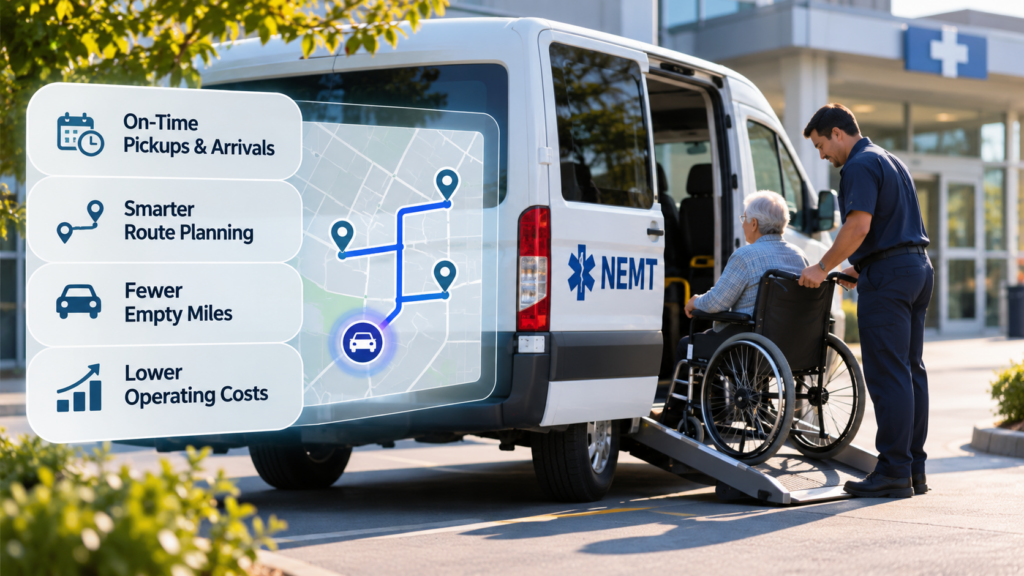
A late pickup is rarely caused by day-of chaos. It is usually baked in the day before. Schedules often look fine on paper but leave no room for things like a delayed dialysis discharge or a wheelchair loading that ran too long. NEMT route optimization builds that wiggle room into the schedule, making on-time performance something you plan for, not something your dispatchers have to rescue by hand.
Why Routes Matter More Than Heroic Dispatching
Every operations leader knows a dispatcher who holds the day together. This is also the risk of manual dispatching. When on-time performance depends on that person to remember which driver is near which health facility, your manifest breaks on the first sick call.
Late arrivals and pickups often trace back to a few structural sources:
- Pickup windows overlap in ways nobody intended
- Drivers are sent unnecessarily across town for a single member
- Schedules are built on guesses about drive times instead of how local traffic actually behaves
The stakes are higher in NEMT than in most other transportation models. Members are often heading to dialysis, chemotherapy, or physical therapy, where a late arrival can mean a shortened or missed appointment. Transportation is a social determinant of health, and reliability is how that principle shows up on the road.
Routing and Trip Assignment Are Two Different Decisions
“Route optimization” is often used to describe two separate jobs. Trip assignment decides which provider or driver receives a trips. Routing decides how pickups and drop-offs are sequenced. Operators with their own drivers, including PACE organizations, have to do both every day.
This post covers the second decision. Trip assignment, the first, deserves its own deeper look in an upcoming post.
What Route Optimization Does in Practice
“Optimization” means little unless you can name the criteria to support it. In NEMT, four matter most:
- Trip packing: Grouping compatible trips while respecting each member’s maximum ride time.
- Pickup window management: Building routes around each member’s individual pickup window, not just estimated drive times.
- Deadhead reduction: Cutting miles driven with no member on board.
- Vehicle and driver matching: Accounting for driver availability, wheelchair accessibility, and escort needs.
Effective dispatch optimization handles all four before the workday starts. This leaves dispatchers free to manage day-of changes instead of rebuilding routes from scratch.
Why Calibrated Planning Beats Guessing
Every route is a prediction, so make sure yours is built on real data. Routes for tomorrow, or later in the week, cannot rely on live traffic, because it has not happened yet. A plan built on well-calibrated road speeds and rush-hour patterns gives you a far better starting point than posted speed limits or flat averages.
NovusMED builds routes on configurable road speeds, so you can update them as local conditions change. Traffic in a large city looks different in winter than in summer, and the plan should reflect that.
Day-of conditions are a separate layer: spotting a run that is slipping and acting on it. The strongest operations treat planning and day-of monitoring as two jobs. A strong plan reduces how much correcting the day demands.
Where the Savings Come From
Cost savings are a byproduct of predictability. When routes are built well, fewer vehicles run empty, overtime shrinks, and fewer trips need last-minute reassignment. Each failed or late trip also carries hidden costs in rework, complaints, and strained relationships with facilities and payers.
Before changing anything, baseline your own numbers:
- On-time percentage by time of day and by facility
- Deadhead miles as a share of total miles
- Trips per vehicle hour
- Overtime hours per week
Those four metrics show whether fleet routing is helping or just rearranging the same problems.
What Members and Health Facilities Notice
Members never see the routing logic. They see a vehicle at the curb inside the promised window, or they do not. Health facilities notice the same thing, because late arrivals ripple through their schedules.
Real-time GPS tracking helps close the loop once the day starts. Dispatchers watching the dispatch screen can see where vehicles are and spot when a run is falling behind. With proper vehicle tracking, delay becomes a phone call made early instead of a “where is my ride?” call made too late.
What to Ask of Route Optimization Software for Medical Transportation Providers
Generic routing tools often miss how NEMT works. Ask any vendor how its system handles ride time limits, mixed ambulatory and wheelchair trips, and driver availability. Ask how their platform supports live traffic delays and sudden changes in weather conditions. Ask how it shows you where on-time performance slips.
NovusMED approaches this as one connected workflow. Scheduling and routing, real-time GPS tracking, driver management, and reporting share the same data. Reporting helps operations leaders see patterns by route, time of day, or facility, then fix the cause instead of the symptom.
Start With Your Own Schedule
The fastest way to judge route optimization is to test it on a day you already know is hard. Book a NovusMED demo and bring a schedule from a difficult workday. We will walk through where the routes could tighten and where the buffers belong.